

Town walks
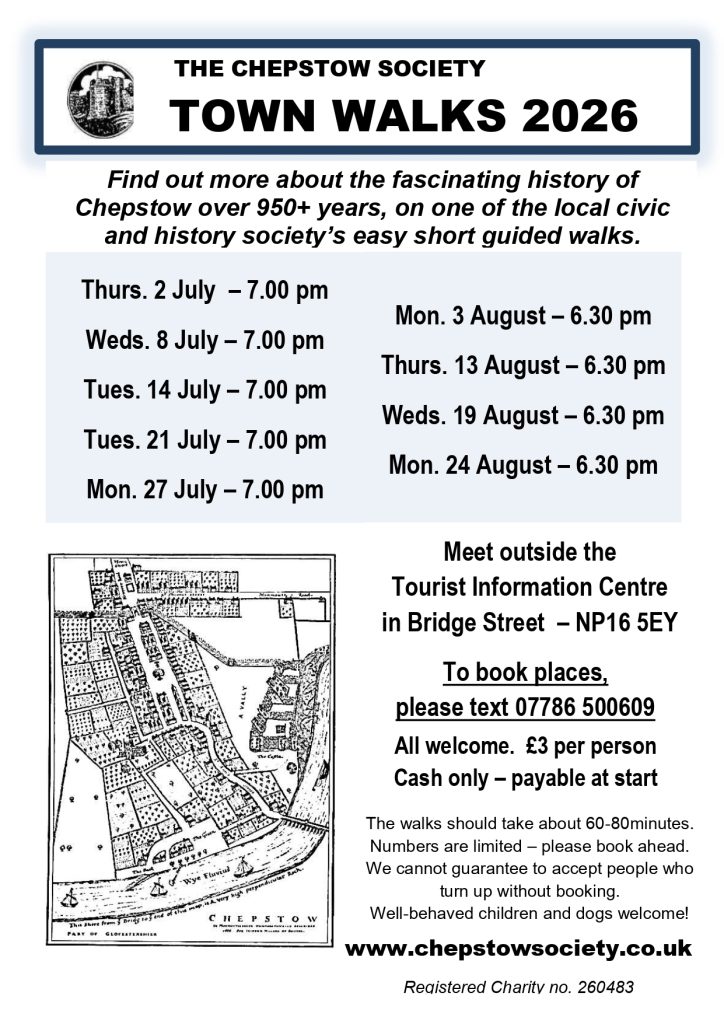
The Society runs a series of walks around historic Chepstow each summer, highlighting interesting features of the town, and their background.
We can also provide guides for groups of at least eight people, on request, for a small charge (in addition to the charge for entrance to the castle, if required).
For further information, please contact Guy Hamilton.
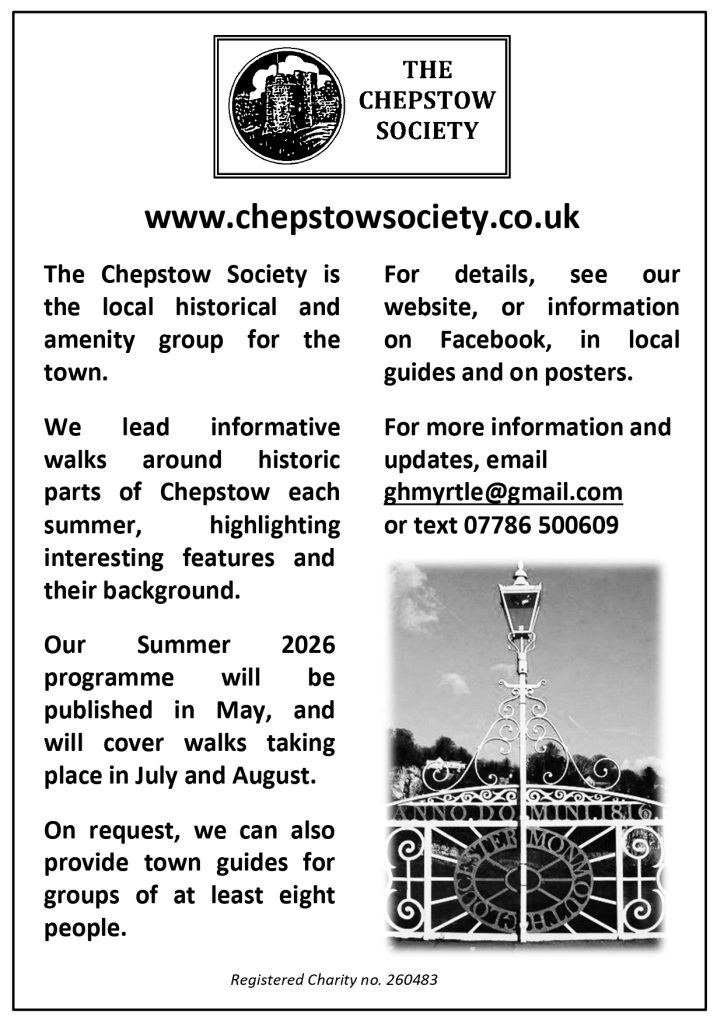
Our regular monthly programme of talks in the Drill Hall is set out here.

Talks
Some leading members of the Society can give illustrated talks on various aspects of the history of Chepstow to local groups, on request.
The Mega Tides of Chepstow and the Severn Estuary
The Severn Estuary and Chepstow have the second highest tides in the world. This talk
looks at the world’s tides and the tides of Monmouthshire and Chepstow – why they are so large, and the implications. The talk also looks at some of the worst storm surges in the past 500 years including the 1606/1607 storm surge likened to a tsunami.
Chepstow Bridge – a bridge of world significance
The case for World Heritage recognition of Chepstow’s five arch iron bridge of 1816 – the
world’s largest iron arch road bridge surviving from the world’s first 50 years of using iron in
construction (1780-1830). Now the world is dominated by iron and steel reinforced
structures. Of the 10 largest iron arch road bridges built in the first 50 years of iron
structures only Chepstow Bridge survives. This is the story of the bridge and its world
significance.
The Severn Bridge – the bridge that changed the world
The construction of the Severn Bridge in 1966 changed the shape and span of 80% of all the world’s long span bridges to follow over the following 50 years. The Severn Bridge’s
revolutionary aerodynamic thin and sleek road deck, copied around the world, was
assembled in the shipyard at Chepstow.
Chepstow Castle and William Marshal, Lord of Chepstow and Earl of Pembroke – the
greatest knight of the Middle Ages.
This talk starts with Marshal’s successful tournament knight career in France and ends with him being ruler of all England, South Wales, and SE Ireland as Regent for the 9 year old King Henry III. At 42 in 1189 Marshal married the 17 year old Isabel De Clare of Striguil (Chepstow). King Henry II referred to his ward as the ‘damsel of Striguil’. She was the wealthiest heiress in the land. Marshal built most of Chepstow Castle and as a major Baron
he brokered the world famous Magna Carta, and ensured its survival when he was the
Regent. Marshal at 70 won the Battle of Lincoln 1217 and drove the French out of England for the final time – he was the ‘Churchill’ of his day and his principal castle was Chepstow. The talk traces William and Isabel’s life and 800 year legacy in Wales, England, Ireland, and America.
Chepstow’s 6 Grade 1 Listed Structures
Chepstow is unusual in having six Grade 1 Listed structures: Chepstow Castle 1067 onwards; St Mary’s Priory Church 1070 onwards; Chepstow’s Port/Town Wall 1282; Chepstow’s Town Gate and Arch 1524; Chepstow Bridge 1816; and the Severn Bridge 1966. Only five C20th bridges in the UK have Grade 1 Listed status. This talk looks at each of the structures and why they merit Grade 1 Listed status.
20 places of International or world significance within 20 miles of Chepstow
This talk is about places or structures or events within 20 miles of Chepstow which have international or world significance. It comprises 20 three to five minute talks called – the Span; the Gondola; the Canal; the Bridge; the Gorge; the Liner; the Chains; the Railway; the Viaduct; the Tunnel; the Telegraph; the Fortress; the Castle; the Ship; the Flood; and so on, taking in locations across South East Wales and Bristol, within 20 miles of Chepstow. The subjects are varied and would be of general interest to any audience but particularly one with an historical interest in this area’s contribution to world industrialisation from the late C18th onwards, and in particular C19th industrialisation.
Chepstow’s Roads – from prehistory to motorway
Chepstow’s road system has emerged – or in some cases been actively engineered – over many centuries. From the time of the Roman crossing of the Wye, through the medieval period when the town gained its castle and market, and on through the time of the turnpike trusts to the late 20th century, the roads in and around the town developed to serve both local and national needs. The talk sets out as much as we know about the history of Chepstow’s road system, fully illustrated with maps, plans and photos from the past.
Chepstow’s Shipyards
This talk covers the history of Chepstow as a shipbuilding centre, starting with the building of wooden ships in mediaeval times and later. In the mid-19th century, Edward Finch came to Chepstow to build Brunel’s railway bridge and stayed to build iron ships and other heavy engineering beside the river. In the First World War, Chepstow was home to National Shipyard No.1, over the next few years launching large merchant ships. The site became the Fairfield Mabey engineering yard, which closed earlier this century. The talk is illustrated with a wealth of photographs of the shipyard at work.
The Old Inns and Taverns of Chepstow
Chepstow was historically both a market town and a port, with many premises that operated as inns and taverns. In some cases, their history can be traced back to the 17th century – others opened for only a relatively short period in the 19th or 20th centuries. The talk covers the whole town, with many illustrations of the old inns and pubs – some in buildings which no longer exist, others which have been converted to other uses, and some which survive to this day.
James Stephens and the Eight Hour Day
Born in Chepstow in 1821, James Stephens became an agitator in the Chartist movement before emigrating to Melbourne in Victoria, Australia, at the time of the gold rush. As a stonemason there, he played a leading role in establishing the movement towards an eight hour day as the standard for working people, gradually adopted around the world. This fully illustrated talk explores his life, its background, and its aftereffects.
Remembering the Great War in Chepstow
First presented for the centenary of the war memorial, this talk focuses on the names on the cenotaph in Chepstow’s High Street, summarising what is known of those who fell in the First World War. It also covers the history of the war memorial itself, and of the naval gun from the war that stands beside it.